
In our shop tiler-market.sk we offer different types of levelling systems from different manufacturers and in the following article we will list the differences between the different systems, their advantages and disadvantages in laying, including the specific products.
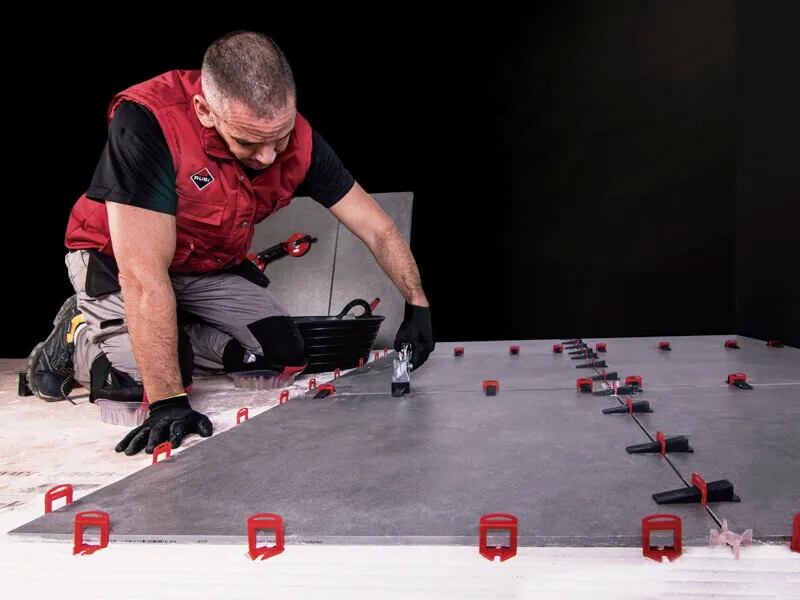
It may have happened to you before that the tiles appear to be level at the start of the installation, but by the third row you may notice that one or more of the edges of the tiles are protruding slightly. On polished porcelain, even a minimal difference in height is immediately apparent. This is not just aesthetic, such unevenness increases the risk of customer complaints. Therefore, a correctly chosen levelling system is not just an add-on for the job, but should be an important part of a professional installation.
Today, levelling systems are not just for large commercial buildings. They have become a common standard wherever a precise level, fast installation is required while meeting the customer’s quality requirements, especially for large format porcelain tiles.
Why use levelling systems?
What does a levelling system do?
For beginners and less experienced tilers, the levelling system helps eliminate height differences between adjacent tiles by creating controlled mechanical tension between them as the adhesive sets. It not only ensures equal joint widths, but actively ‘pulls’ the edges of adjacent tiles into a single plane. In practice, this means fewer protruding corners, less post-taping and less need for continuous inspection with a batten or ruler. When used correctly, the pressure is evenly transferred to the edges of the tiles, helping to maintain a perfect plane across the entire surface.
The main advantage is greater control over the laid tiles. Instead of additional repairs of non-adjacent edges, you eliminate their movement already during the hardening of the adhesive.

When is it needed?
Large-format porcelain has greatly increased the demands on laying accuracy. Formats of 600 × 600 mm, 900 × 900 mm or 1200 × 600 mm are more responsive than smaller ceramic tiles, and even minor inaccuracies in the adhesive bed will quickly show up on a larger surface area.
If you work with
- rectified tiles,
- polished porcelain,
- large format or thin panels,
- narrow joints,
a levelling system is no longer just a recommendation. It is a practical solution that helps prevent installation errors. With wall tiles, especially heavier porcelain elements, gravity increases the risk of shifting while the adhesive is setting. The levelling system also helps to limit downward slippage and keep joints in a precise line.
What it can’t fix
A levelling system is not a substitute for good substrate preparation. It does not level uneven substrate, does not eliminate defects in the adhesive bed, does not resolve structural deflection or incorrectly selected adhesive. If the substrate does not meet the requirements for a quality installation, the system will only transfer the existing problem to the final installation.
Main types of levelling systems
If you understand the mechanical differences between the different systems, you will find it easier to choose the solution that best suits your needs and way of working. Therefore, let us briefly explain the types of levelling systems.
Clips and wedges
It is one of the most widely used types of levelling systems. A disposable clip is inserted under the tiles and a reusable wedge is inserted into it to create the necessary pressure. They are fast, easy to use and very effective for most flooring applications. That’s why many professionals consider them one of the most practical solutions for routine installation. In our shop you will find this type of system from different manufacturers, e.g. the levelling system RUBI DELTA, BATTIPAV or Raimondi R.L.S.. Each manufacturer, based on its own development, optimizes the shape and materials used for the clips and wedges in order to provide the customer with the best possible product in a given price range. It is therefore also necessary to use the manufacturer’s recommended levelling pliers for tightening the wedges in the staples, which perfectly fit the designed shape of the staples and wedges.
Reusable systems
Reusable systems reduce waste by using reusable clips instead of disposable clips. They are particularly suitable for construction companies that are concerned with sustainability and long-term cost-effectiveness. On the other hand, they require consistent cleaning and more careful handling.
All-in-one and Screwdriving systems
Screw or rotary systems can combine both the clamp and the tensioning mechanism (adapter) into one element, or they can be separate. These systems allow easy tightening without the need for additional tools. The advantage is ease of use, but tension control tends to be less precise compared to professional wedge systems. The adapters are tightened by hand, so they are particularly interesting for smaller projects or for less experienced users. Based on experience, we would recommend bolt-on systems with separate adapters. Such systems include the RUBI CYCLONE levelling system , TRIUSO, or the Raimondi R.L.S. Vibe. However, there are also jigs for tightening the adapters with a drill, e.g. Raimondi R.L.S. VITEXPRESS.
RUBI offers the QUICK and TILE LEVEL levelling system, which combines the shape of the adapters from screw systems and the principle of wedge attraction.
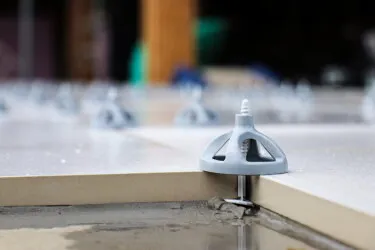
Levelling elements with integrated distance function
Levelling systems often combine both levelling and distance function in one element. This makes installation faster and eliminates the need for separate distance elements. The disadvantage is less flexibility in projects where different joint widths are used. This can be solved by using staples with different joint widths. Every good manufacturer offers staples with different joint widths within the product range, most commonly in widths from 1 to 3 mm.
| Type of levelling system | Benefits | Disadvantages |
| Clips and wedges | + fast installation + favourable price + good pressure control + wide range | – clips for 1 use |
| Reusable systems | + more environmentally sustainable solution + less waste in use | – higher initial investment – effective for larger projects |
| Screwdriving systems | + easy to use + also suitable for hobby use | – less precise pressure control |
Kits and accessories for levelling systems
For larger projects, the need for staples, wedges and adapters can be in the hundreds to thousands, which is why we offer discounted sets of up to 2,400 of these parts. We also offer a range of starter and levelling kits for different joint widths, which include everything needed to start the installation (clips, wedges/adapters, pliers). We recommend that you purchase this kit and then only purchase the missing material, most often clips.
Several manufacturers are constantly pushing the development of levelling systems to the next level and bringing innovative solutions to facilitate, speed up and improve the quality of paving. For example, from Raimondi we have a range of levelling tongs with a unique shape, designed for tightening wedges on walls, or protective pads for wedgesto protect sensitive tile surfaces from damage. Similar pads are also offered by RUBI for the DELTA and CYCLONE systems.
How to choose the right levelling system
Dimension and thickness of tiles
For large format porcelain, higher tension and a wider base of the clasp are important to limit bending. For panels and heavier tiles, the system should be selected according to compatibility with the thickness of the material. In our range you will find clips designed for different tile thicknesses, e.g. clips up to 12, 15 or up to 20 mm thick. If you regularly work with 900 or 1200 mm formats, choosing the right system for large format tiles should be a priority.
Type of laying
Floor applications generally require higher compressive strength than wall cladding. In addition, temperature changes and a thicker adhesive bed also come into play outdoors. For large commercial areas, durability and speed of work are the main factors, while for designer walls, precision and surface protection are more important.
Reusability and cost-effectiveness
Disposable staples have a lower cost per piece, but increase ongoing material costs when used on a regular basis. Reusable systems reduce waste but require systematic cleaning. For smaller volumes of work, one-off solutions may be more practical, but for larger projects, reusable components are often more worthwhile.
Ease of use and quality of deburring
The quality of breaking off the staples is also important. Cleanly breaking off the staple below the edge of the tile prevents sharp residues being left in the joint, which would make grouting difficult. It is often the breaking behaviour of the staple that differentiates cheaper solutions from professional systems, so it pays to test it before buying a larger quantity.
Recommendations for a perfect paving result with the levelling system
Check the alignment of the tiles before tightening the adapters. Once the system is tightened, further correction is more difficult. It is therefore worth checking the plane of the tiles with a batten or ruler before final tightening.
Clean the clips before the glue hardens. Glue residue around the clips can make it difficult to remove them properly. Cleaning them continuously during installation helps to avoid problems during debonding.
Remove clips, wedges or adapters in a controlled manner to avoid chipping. After the adhesive has cured, remove the system by punching or kicking in the direction of the joint. The upward force may damage the rectified edges. Controlled removal thus protects both the tile surface and the joint itself.
Combine the system with quality spacers for a flawless result. Although the vast majority of systems already incorporate integrated spacers, many professionals still use separate elements to precisely maintain the width of the joints. Leveling addresses flatness, spacers ensure uniform joint widths – ideally they work together, not separately.
Levelling systems are no longer just an optional accessory. They are practical working tools that help to achieve a consistent result, limit repairs and maintain efficiency in execution. Making the right choice means matching the type of system to the tile format, the required pressure and the nature of the project. For pro tilers who demand precision without unnecessary complexity, we offer advanced leveling solutions designed to suit real site conditions. If the flatness of the final installation is decisive, the right system is not just an advantage, but the basis for a high-quality implementation.