
Knowing how to cut irregular shapes into tiles — especially large-format porcelain tiles — is becoming an essential skill for professional tilers today. Modern projects and their designs increasingly call for larger tile formats, narrower grout lines, and more complex layouts. Precise cutting of irregular shapes into large-format tiles is therefore becoming a routine part of everyday practice.
You’re in the middle of installing a 1200 x 600 mm porcelain slab when you run into a drain pipe, a recessed electrical box, or a tricky inside corner. Irregular cuts and shapes can complicate the entire installation. One wrong move, too much pressure, or a slight vibration at the wrong moment, and the tile can crack. With large-format porcelain, a mistake like this can be very costly, frustrating, and time-consuming.
Why is cutting irregular shapes into large-format tiles so challenging?
Size, thickness, and fragility of large-format tiles
Large-format tiles behave differently than standard 300 x 300 mm ceramic tiles. Their size amplifies internal stresses. Even a small torsional force during handling can send a crack spreading across the entire tile.
Most large-format porcelain tiles are between 6 and 12 mm thick. Thinner panels are more flexible but also more sensitive to vibration and point loads. Thicker slabs are structurally stronger, but cutting them cleanly is more demanding, especially when creating internal cutouts.
When cutting large-format tiles, the hardness of the porcelain itself usually isn’t the only challenge. The risk comes from a combination of material density, format size, and unsupported sections. Every irregular cut creates points of concentrated stress. If these aren’t handled correctly, damage to the material is almost inevitable.
The most common irregular cutouts
On job sites, irregular cutouts are rarely just decorative. They usually serve a functional purpose.
The most common cutouts you’ll encounter include:
- Curved cutouts around sanitary fixtures
- L-shaped cutouts around door frames and concealed piping
- Circular holes for pipes and fittings
- Cutouts for outlets and switches in walls
- Notches around steel frames or structural elements
Each of these cut types creates internal angles. And internal angles are critical, because they act as stress multipliers. A sharp inside corner in porcelain is a natural starting point for a crack if it isn’t properly “relieved.”
Risk of damage and material costs
Large-format porcelain tiles leave no room for error. A botched L-cutout often means the whole tile is ruined. On premium residential or commercial projects, this can translate into significant extra costs and delays.
Damage most often occurs for three reasons: the tile isn’t sufficiently supported during the cut, the tool generates excessive vibration, or the diamond blade is pushed through the material too aggressively. In all three cases, the tiler usually feels resistance while cutting before a crack actually appears. Recognizing this feedback should be part of every professional tiler’s skill set.
Key tools for precise cutting of irregular shapes
Precision starts with choosing the right equipment. Standard tools designed for small formats aren’t always suitable for cutting large-format porcelain tiles. That’s why it’s important to choose the right tools and accessories — which, to make your selection easier, we’ve grouped together in a single category in our store: Tools for Large-Format Tiles.
When it comes to scoring the glaze directly and making a controlled snap, manual cutters for large formats still have their place. There are manual cutters with a classic design offering a maximum cutting length of over 160 cm (e.g. Rubi TZ, Rubi RCH, Battipav SINTESI, Kaufmann TopLine PRO). There are also manual cutters or cutting systems that use connectable guide rails and a cutting trolley for straight cuts. These systems allow cuts over 3 meters long (Raimondi, Battipav, Rubi). Our range also includes more specialized manual cutters with broader cutting capabilities — such as the Raimondi T-CUT or the Raimondi KOMPASS for cutting curved shapes.
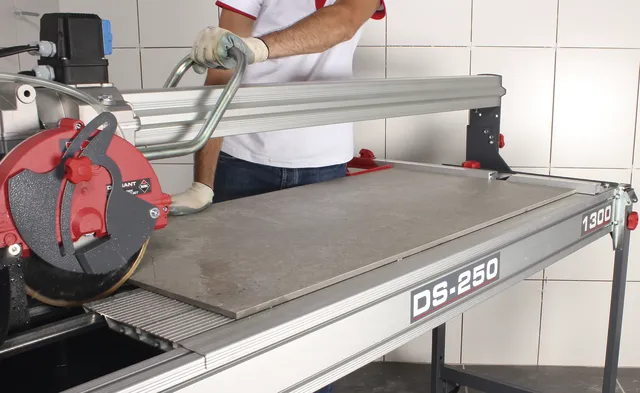
If you often need to make inside corners or curved lines, we recommend switching to electric cutters, which offer several advantages. A water-cooled saw system guided along a rail (bridge) provides enough stability for straight, controlled, low-vibration cuts even on very long cuts. Specialized systems designed for large slabs minimize deflection, distribute pressure evenly, and provide the stability and control needed for cutting.
Angle grinders and diamond blades for curved cuts
For curves and freeform shapes, an angle grinder fitted with a quality diamond blade remains the most versatile solution.
Blade selection is crucial. Continuous-rim blades reduce chipping on glazed porcelain. Turbo blades speed up cutting but can reduce edge quality. With sintered stone or very hard materials, choosing the right blade helps limit microcracks along the cut line. Keep in mind that control matters more than speed. Excessively high RPM combined with aggressive feed rate generates excess heat and vibration. Both contribute to edge damage.
Drill bits and core bits for circular holes
When creating circular holes for pipes or fittings, core drilling is a better choice than attempting a so-called plunge cut with an angle grinder.
Diamond core bits distribute stress evenly around the entire circumference of the hole. Drilling from the face side with water cooling keeps the temperature from rising too much. Our range includes a wide selection of diamond core bits from various manufacturers, with different specializations and precise diameters (from 6 to 120 mm), so you can create a circular hole for various pipes or electrical boxes with a single drilling operation. We also recommend using various accessories and value-priced sets of diamond core bits in different diameters, which can help you save on costs.
Trying to form a circle by joining several straight cuts creates sharp internal angles. Once the tile is installed, these often become points of failure.
Work tables and handling systems for safe work
Material support during work is often underestimated. Cutting large-format tiles on an unstable surface or carrying them incorrectly are among the leading causes of damage.
A sturdy work table with full-surface support for the tile prevents it from flexing. If the tile vibrates during cutting, the blade can catch, creating microcracks along the cut line. A quality support system acts as a stabilizing platform and reduces torsional stress during cutting. We recommend robust work tables such as the Battipav MULTI Bench or the Rubi SLAB, which can be used not only for working with large-format tiles but also for everyday construction or tiling jobs.
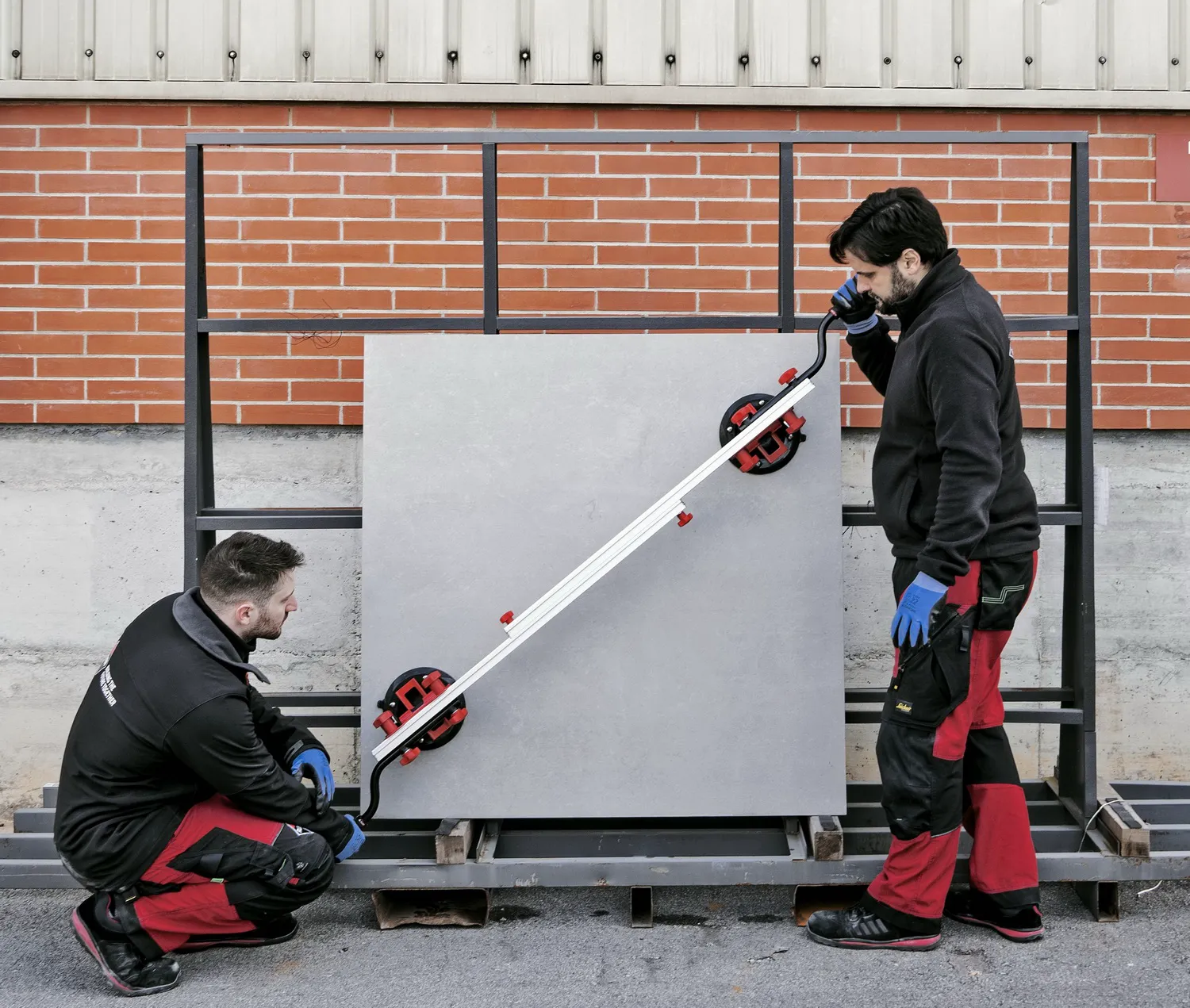
Handling systems for large-format tiles use multiple vacuum suction cups to distribute stress across different points and sections of the tile while it’s being carried or installed. These systems are designed to support heavy loads without flexing or shifting and can be adjusted to fit different tile sizes. Several trusted manufacturers offer products that differ in load capacity, supported tile dimensions, or compatibility with other components of large-format tile handling systems. From Rubi, these are primarily the SLIM series and the top-tier SLAB series, while Battipav offers the AGILE series.
How to cut different types of irregular shapes, step by step
Cutting curves and rounded shapes
Start by marking the curve precisely using a template, a copying jig, or a compass. With expensive tiles, it’s not worth relying on a freehand estimate.
Cut along the marked line with the grinder, starting shallow rather than attempting full depth in a single pass. Multiple shallow passes reduce both heat and vibration. As you approach the final millimeters, slow down the feed rate and let the blade finish the cut without excessive pressure. If possible, relieve stress by removing excess material in sections before completing the curve. This reduces the weight pulling against the cut edge.
Making L-shaped cutouts and corner notches
L-shaped cutouts are among the most common causes of tile damage. A critical mistake is cutting straight into a 90-degree inside corner. Instead, first drill a small relief hole at the inside corner to release tension. Then complete both straight cuts up to the edge of the hole. The result is a rounded inside corner instead of a sharp angle.
Never try to snap out an L-shaped cutout after only a partial cut. Large-format porcelain doesn’t behave like a small ceramic tile. It cracks unpredictably.
Cutting holes for pipes, outlets, and mounting hardware
When cutting through-holes for pipes, measure precisely and double-check the position before drilling. Start drilling at a slight angle to establish a groove, and only set the core bit perpendicular to the surface once the groove is formed.
For rectangular cutouts for outlets, first drill each corner to create “relief points.” Then connect the corners with controlled straight cuts using a grinder. This technique minimizes internal stress.
Best practices for clean, precise cuts
Measuring, marking, and planning the cut
Precise cutting begins before the blade ever touches the tile. Verify all dimensions against the actual installation position, not just the plan — walls are rarely perfectly square. Mark the cut line clearly with a soft pencil or a non-permanent marker. On large-format tiles, even a 2 mm deviation can create visible inaccuracies over a large surface. Dry-fitting the slab before the final cut lets you check clearances and grout line alignment.
Controlling speed, pressure, and vibration
Forcing the blade through the material is the fastest way to ruin a tile. Let the blade cut at the pace it’s designed for. Excessive downward pressure increases both friction and heat. Keep the RPM steady and the feed rate even. If you notice increasing vibration, stop and check the condition of the blade. Worn diamond segments reduce cutting efficiency and increase the risk of microchipping.
How to reduce chipping on porcelain and sintered stone
Chipping is most often the result of the wrong blade, poor cutting technique, or insufficient material support. Use continuous-rim blades on visible edges. If the surface glaze is especially sensitive, apply masking tape along the cut line. Most importantly, the tile must be fully supported in the cutting zone.
For finished visible surfaces, it’s generally better to cut from the face side, since minor edge imperfections tend to form on the exit side of the cut.
Safety recommendations and common mistakes to avoid
Personal protective equipment and safe handling
When working with large-format slabs, safety doesn’t stop at eye protection. You should also use:
- Safety glasses or a face shield
- Cut-resistant gloves
- Hearing protection
- Dust extraction or respiratory protection when dry cutting
Handling large tiles also requires proper lifting technique or mechanical assistance. Twisting a tile while moving it can cause cracks before cutting even begins. This is exactly what the handling systems mentioned earlier are designed for.
Mistakes that lead to cracking and damage
The most common mistakes happen when the tile isn’t sufficiently supported near the cut line, when inside corners aren’t “relieved,” or when excessive force is applied during cutting. The main cause is usually rushing. Patience and controlled execution should be fundamental to your work.
When to change your tools or cutting technique
If you notice excessive vibration, burn marks, or inconsistent edge quality, reassess your entire approach. A worn blade, an unstable work surface, or poorly chosen tools will only make the result worse.
Conclusion
Professionals know how to adapt. Cutting large-format porcelain tiles requires a flexible technique based on thickness, material density, and cut type.
Mastering the cutting of irregular shapes into tile means understanding the material’s behavior just as well as the tool’s. Large-format installations demand precision, planning, and the right equipment to effectively control stress and vibration.
When you combine stable support systems, quality diamond blades, and electric cutters designed for this type of work, even complex shapes turn from a risky, unpredictable task into a process you’re fully in control of. This is where experienced professional tilers achieve greater efficiency, save time and money, and deliver a quality result.
To make things easier for you, our range also includes discounted tool sets for large-format tiles from individual manufacturers, letting you save even more. You’ll find everything you need in the Tools for Large-Format Tiles category. And you’ll find all our diamond cutting blades in the Diamond Blades category.
And don’t forget, if you need advice, we’re here for you.